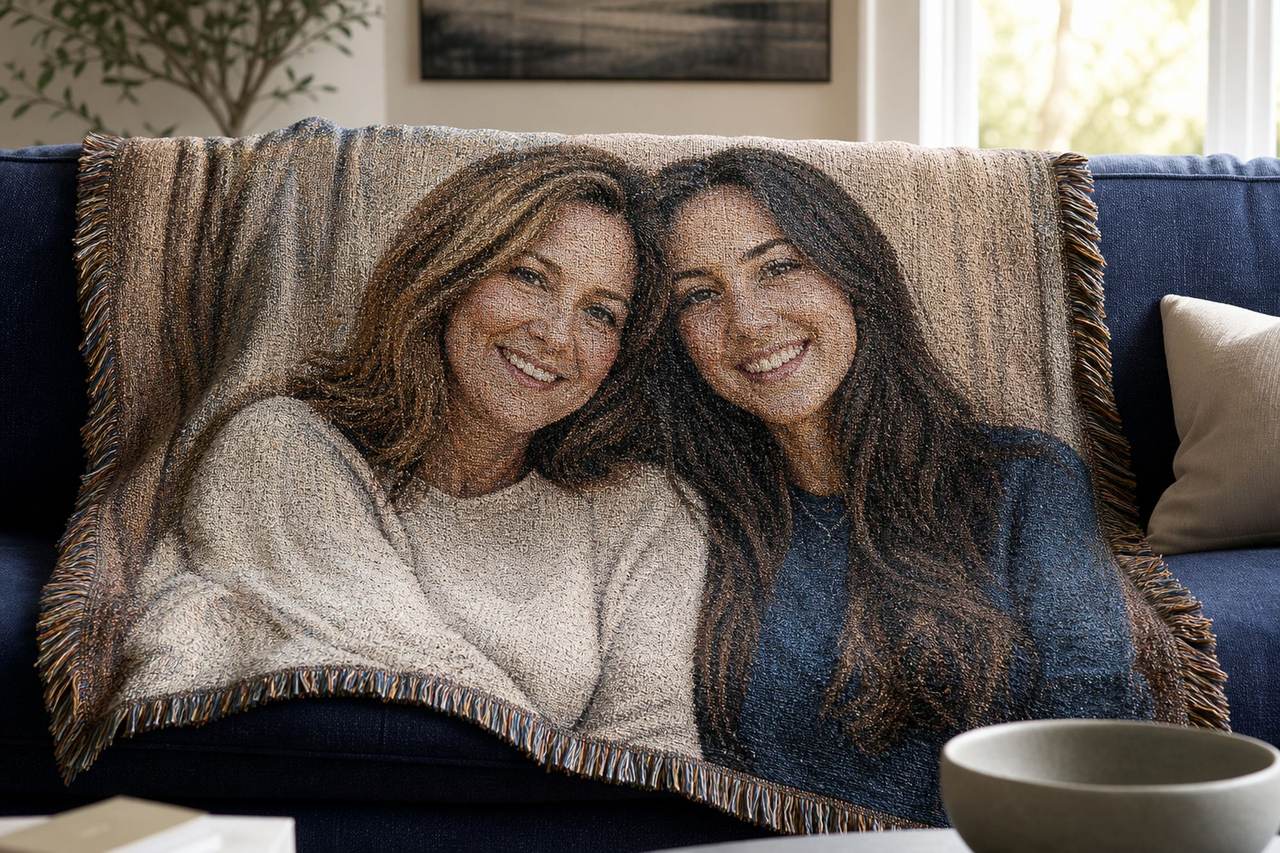
Concept visual · not a customer order photo
Guide · Photo readiness for yarn weaving
High Resolution Photo for a Woven Blanket — What Actually Matters
If you searched for a high resolution photo for woven blanket prep, you probably already chose yarn-woven craft over printed fleece—and now you want to know whether your file is good enough before you send it. This guide explains clarity, lighting, and framing for loom weaving without invented megapixel cutoffs. Oohfu reviews every share with your quote and tells you plainly what will work.
Quick answer: resolution for woven blankets
A high resolution photo for a woven blanket is not the same checklist printed fleece shops publish. Yarn weaving translates your image into colored threads on a loom—an artistic, tapestry-like result—not continuous-tone ink on polyester. Start with your strongest original: camera roll, clean scan, or exported library file—not a screenshot, social download, or forwarded chat thumbnail.
Practical tests beat fake rules: pinch-zoom on faces; check that lighting is even; make sure the subject fills enough of the frame. Share size intent when you inquire—a lap throw and a large display piece ask different things of one file. We confirm feasibility in your quote reply; we do not invent minimum pixel counts on this page.
Why woven blankets ask different things of your photo
Most “photo blanket” advice online comes from sublimation fleece makers. Their process bonds dye into polyester fiber and can mask a compressed phone snapshot for a season. A woven photo blanket builds the picture from interlaced yarns—closer to cloth art than a glossy printout. Fine detail softens into weave grain up close; from a normal sofa distance, faces and scenes still read clearly when the source file is honest.
That difference is why shoppers search high resolution photo for woven blanket separately from generic share pages. You are not chasing photorealistic ink—you are giving the loom enough real information to map into a finite yarn palette. Neon filters, tiny background figures, and heavy shadows fight that translation more than a missing number on a spec sheet.
For the craft contrast in plain language, read woven not printed or woven vs printed photo blankets. This guide stays focused on the photograph itself.
What we will not do: invented megapixel laws
Search results love hard numbers—minimum kilobytes, mandatory DPI at final size, exact pixel widths for every throw dimension. Those lists come from individual print shops and loom templates, not universal truth. Oohfu will not publish fake minimums on this guide just to sound authoritative.
Instead, think in two layers: starting quality (how much real detail your file actually contains) and viewing intent (how large the finished cloth will be and how close people stand to it). When you request a quote, tell us both—we review the file and reply with an honest yes, a suggested crop, or a gentle redirect to a better source.
The zoom test (practical, not a spec sheet)
Open your candidate photo on the device where it looks sharpest. Pinch to zoom on the faces, pet eyes, or main subject you care about. If detail turns to mush immediately, the weave will struggle too—especially for a throw meant to drape on a sofa where viewers stand closer than they would to a wall poster. If edges stay reasonably clean at moderate zoom, you are usually in a reviewable range. Send that file.
Bigger cloth, bigger ask—not a magic formula
A modest lap throw and a large display piece do not ask the same thing of one photograph. Share how you plan to use the blanket—couch accent, bed throw, wall display—when you inquire. Exact dimension options are confirmed in your quote reply, not listed as a storefront grid here. See blanket vs throw size guide for how size intent shapes expectations.
Do not upscale in editing apps
Increasing pixel dimensions in software does not create detail that was never captured. If the only copy you have is small, tell us—it may still work at a modest size, or we may suggest a simpler crop. Restoration beyond basic review is discussed case by case in the quote thread, not promised as automatic magic.
Lighting: the quiet hero of weave-ready photos
Resolution talk often ignores lighting, yet bad light wastes a technically large file faster than any missing megapixel. Yarn weaving reads contrast between light and dark areas; harsh shadows and silhouettes flatten into muddy cloth. A high resolution photo for woven blanket prep starts with light that flatters the subject—not just a big file size.
Lighting that usually weaves well
- Soft natural daylight — overcast outdoor light or indirect window light gives even illumination without deep eye sockets.
- Golden hour warmth — sunrise and sunset glow often translate beautifully into yarn tones.
- Outdoor shade on sunny days — bright but diffused, without squinting or raccoon shadows.
- Well-lit indoor spaces — multiple soft sources beat a single harsh ceiling bulb.
Lighting that often fights the loom
- Strong backlighting — subjects become dark silhouettes against bright windows or skies.
- Harsh direct flash — flat faces, red-eye, and hard shadows behind heads.
- Low-light grain — restaurant candles and dim venues produce noise that reads as speckled yarn.
- Mixed color temperatures — warm tungsten plus cool daylight in one frame confuses palette mapping.
If the memory matters emotionally but the lighting is imperfect, share it anyway and explain the story. We would rather review honestly than send you hunting for a perfect studio shot that does not exist.
Face size, focus, and framing
Woven blankets reward photos where the people you care about are large enough in the frame that eyes stay readable when you zoom in on the file—not tiny figures lost in a wide crowd. Professional portrait sessions, newborn close-ups, and clear couple shots usually weave more cleanly than busy group panoramas unless you discuss layout in the quote thread.
Eyes and focus
Sharp eyes are the fastest signal of weave viability—for humans and pets alike. If the camera focused on background clutter instead of faces, no resolution checklist will save the throw. On phones, tap-to-focus on the subject before you shoot; on older prints, prefer a flatbed scan over a glare-filled snapshot of an album page.
How much of the frame should faces fill?
There is no single inch measurement we will invent here. Use the zoom test: if you can still read expression at moderate pinch-zoom, the subject is probably large enough for a standard throw layout. For wall-display intent, err toward tighter crops—viewers may stand closer than they would to a folded couch blanket.
Group photos and collages
Large family reunions can work when faces are close and evenly lit, but ten distant heads across a lawn rarely survive yarn translation at blanket scale. If you need multiple people, consider which single hero image carries the gift story—or describe a collage idea in your quote request so we can discuss feasibility before you commit.
Best file sources—and files that usually fail
The strongest share is almost always the original—the version saved straight from your camera or scan workflow, before apps shrink it for sharing. Full share mechanics and privacy notes live on share photo; this section summarizes what matters for resolution readiness.
Start here
- Camera roll originals — photos taken on your phone or digital camera without re-sharing through apps.
- Clean flatbed scans — paper prints scanned once, evenly lit, beat phone photos of glossy album pages.
- Exported library files — full-quality export from Photos, Lightroom, or similar—not a dragged thumbnail.
- One clear hero image — a focused portrait usually beats a five-photo collage unless layout is discussed in the quote.
Usually trouble
- Screenshots and screen captures — they look fine on a phone display but carry less real detail when enlarged into cloth.
- Social-media downloads — platforms compress images for feeds; those files rarely survive a large throw.
- Forwarded chat images — messaging apps shrink photos automatically; ask senders for the original by email or cloud link.
- Heavy beauty filters and extreme HDR — they can fight the finite yarn palette and make faces look flat when woven.
JPG and PNG from everyday cameras are what most inquiries use. HEIC from iPhones is common too. We do not publish a closed “approved extensions” list as law; attach what you have and tell us where it came from.
Contrast, color, and the yarn palette
Jacquard-style weaving maps your photo into a limited set of dyed yarn colors—not infinite RGB like a monitor. High-contrast images with clear separation between subject and background usually read better than low-contrast haze. Neon phone screenshots and ultra-saturated filters may soften into warmer woven tones; that is expected textile behavior, not a defect we hide.
Small text, license plates, and fine jewelry detail often blur at throw scale—plan for likeness and mood, not micro-print readability. Landscapes with strong horizon lines and simple skies can weave beautifully; busy forest texture may become impressionistic yarn grain.
If you are comparing expectations against printed fleece sharpness, read woven vs printed photo blankets before you judge your file too harshly. Woven is chosen for heirloom texture and cloth character—not pixel-perfect poster replication.
Pet photos and memorial likenesses
Pet portraits follow the same clarity rules with extra emphasis on eyes: if fur is soft but eyes are sharp and well-lit, the image usually reads as high quality on cloth. Outdoor pet photos with open shade often beat indoor flash bouncing off glossy coats.
Memorial and milestone gifts deserve calm handling—no urgency marketing, no “cheer up” tone. If you are planning a remembrance piece, choose a respectful portrait with even light and a subject large enough in frame; emotional weight does not replace technical honesty, but we review gently when the story matters. Share mechanics are the same as any other inquiry; tone-specific context stays on dedicated gift pages, not duplicated here.
Common mistakes before share
- Chasing a blog’s minimum pixel count while sending a compressed social download that fails the zoom test.
- Upsizing a small file in an app and believing the new dimensions added real detail.
- Picking the prettiest filter instead of the clearest original—filters fight yarn palettes.
- Assuming woven equals printed sharpness and rejecting a good file because it will not look like sublimation fleece.
- Waiting for perfection when a reviewable original exists today—quote review costs nothing on this site.
- Forgetting size intent — the same file may work for a modest throw but not for an ambitious wall display without crop discussion.
When in doubt, send the best original you have with a short note about gift timing and intended use. We reply with an honest assessment—not a generic rejection template.
What happens when we review your photo with your quote
Oohfu is quote-only: no checkout cart, no storefront price grid, no automatic order when you attach a file. After you share your photo through the paths on share photo, we assess weave feasibility—crop, contrast, size fit, optional text, and timing—then reply by WhatsApp. Nothing is production until both sides confirm in writing.
Your quote reply is where exact dimensions, material specs, preview steps, and production windows are confirmed—not invented on this educational guide. If we suggest a tighter crop or a different source image, that conversation happens before you commit—not after cloth is on the loom. Full sitewide process overview: how it works.
-
Choose your best original
Apply the zoom test, lighting check, and framing notes above—not a forwarded thumbnail.
-
Share size and gift intent
Tell us throw vs display use, quantity band, destination city, and any need-by window when you inquire.
-
We review and quote
We assess whether your high resolution photo for woven blanket prep suits yarn weaving at your scale, then reply with a custom quote.
-
You approve before weaving
Plan and crop alignment happen in the quote thread—see how it works for the full path.
FAQ — high resolution photo for woven blanket
Do I need a specific megapixel count for a woven photo blanket?
There is no universal megapixel law for yarn-woven blankets. What matters most is a clear, well-lit original—not a compressed social download or screenshot. Oohfu reviews your file with your quote and tells you plainly whether it will weave well at your intended size.
What makes a photo high resolution enough for weaving?
Start with the best original you have from a camera roll, scan, or exported library file. Pinch-zoom on faces: if detail holds at moderate zoom, the file is usually worth sending. Sharp focus, even lighting, and a subject large enough in the frame matter more than chasing a checklist number on a blog.
Why do woven blankets need different photo prep than printed fleece?
Printed fleece uses ink or dye on polyester and can hide some compression. A woven blanket builds the image from colored yarns on a loom, so soft detail becomes part of the textile character while badly compressed files struggle. Expect a tapestry-like result, not pixel-perfect photo realism.
Can I use a photo someone texted me?
Forwarded chat images are usually too compressed once enlarged into cloth. Ask for the original file by email or cloud share instead. If the only copy you have is small, share it anyway—we review honestly in your quote and may suggest a tighter crop or a different source.
How big should faces be in the photo?
Faces should be clearly visible and large enough in the frame that eyes stay readable when you zoom in on the file—not tiny figures in a wide crowd shot. A single portrait or close couple photo usually weaves more cleanly than a busy group unless you discuss layout in the quote thread.
What happens after I share my photo for a quote?
We review weave feasibility—crop, contrast, size intent, and timing—then reply with a custom quote by WhatsApp. Nothing is an order until both sides confirm. Exact dimensions, material specs, and production windows are confirmed in that quote reply, not invented on this guide.
Ready to send your best file?
You do not need a perfect studio portrait—just your strongest original, honest lighting, and a subject large enough to read in yarn. When your photo is chosen, continue on our share guide or product hub. We review every file with your quote.