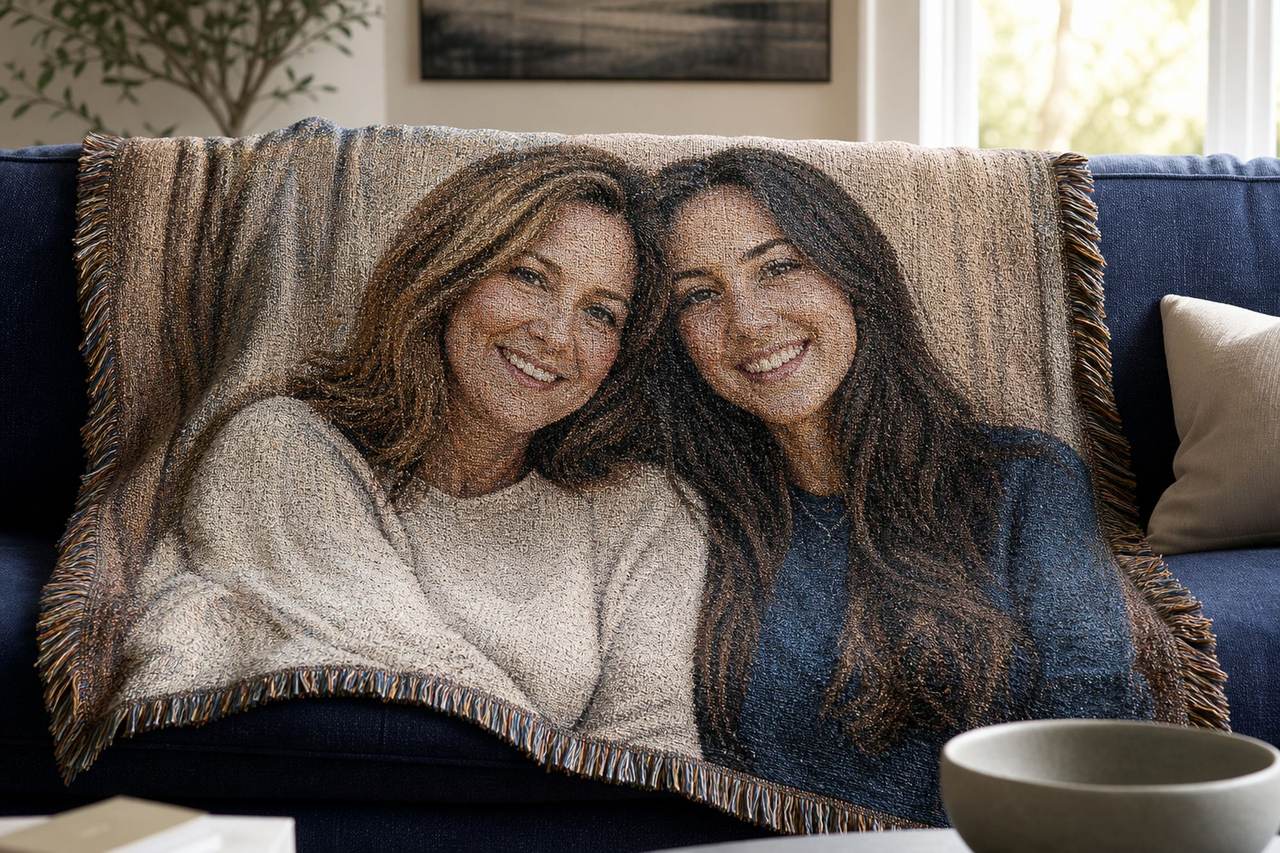
Concept visual · not a customer order photo
Guide · Craft comparison
Woven vs Printed Photo Blankets — What Actually Differs?
If you searched woven vs printed photo blanket, you probably already own — or almost bought — a soft fleece throw with a picture on it. This guide compares how each craft is made, how the photo looks at arm’s length and up close, how each type ages with use and washing, and when yarn-woven construction is the better gift path. Oohfu makes custom yarn-woven photo blankets; we do not sell printed fleece here. We explain both sides so you can choose with clear eyes.
Quick answer: woven vs printed photo blankets
A printed photo blanket — most Amazon listings, pharmacy kiosks, and print-on-demand fleece — puts your image on the fabric surface, usually through dye-sublimation on polyester fleece or sherpa. Day one can look sharp and colorful; the picture lives as dyed fiber on a pre-made textile.
A woven photo blanket builds the image with colored yarns on a loom (often described as jacquard-style weaving). The picture becomes part of the cloth structure — closer to a tapestry than a photo print enlarged onto fabric. Faces read clearly from a few feet away; up close you see yarn grain. There is no ink film sitting on top waiting to peel.
Which is “better”? Better for heirloom texture, wash structure, and “not another fleece print” → woven. Better for pixel-sharp photo realism and plush everyday snuggle on a fast catalog timeline → printed fleece or sherpa (elsewhere). Neither is fake. They solve different gift problems.
Why shoppers compare woven and printed
The phrase “photo blanket” hides three different products. Marketplace listings rarely lead with process words like sublimation or jacquard weaving. You see the same friendly label — custom photo blanket — above objects that share almost nothing in how they are built. That is why comparison searches spike: buyers want to know whether they are getting cloth art or a printed textile before they commit money and a favorite photo file.
Typical compare shoppers have already handled a printed throw. Maybe the pile felt thin, colors dulled after a few washes, or the gift read as “bulk personalized” rather than something you would drape on a sofa back or hang with intention. Others saw a woven sample at a craft fair or in a wedding gift thread and wondered whether the price gap reflects real craft or only marketing language.
This page sits in our photo blanket comparisons cluster — educational first, not a checkout lane. For the full “yarn in the fabric, not ink on fleece” process story, see woven not printed. For a deeper technical lane on sublimation specifically, read our new guide yarn woven photo blanket vs dye sublimation.
How printed photo blankets are made
Most mass-market custom photo blankets start as a blank polyester textile — fleece, minky, or a sherpa-style construction with a smooth printable face and a fluffy reverse. Your digital file is resized, sometimes auto-enhanced, then transferred onto that blank.
Dye-sublimation (the common path)
Dye-sublimation heats solid dye until it becomes a gas, then bonds with polyester fibers under pressure. When done on a proper high-poly blank, the image sits inside the fiber rather than as a stiff film on top — which is why good sublimation resists cracking better than cheap iron-on transfers. Still, the “photo” is a dyed surface on a finished fabric; it is not interlaced yarn forming the picture during weaving.
Industry guides (Printify, That Blanket Co, RareCustom) consistently describe printed fleece and sherpa as the sharp, colorful, fast-turnaround end of the category. Soft pile, saturated color, and photographic detail are the trade you get. The reverse is often plain white or solid color; the design does not structurally exist on both faces the way real jacquard weaving can.
Other print methods you may see
Some cotton or blended blankets use direct-to-garment (DTG) or screen printing. These can look vivid on day one but may behave differently under abrasion and laundry than sublimation on polyester. When comparing durability, ask which print method and which fiber — not just “custom photo blanket.”
Marketing sometimes blurs lines further: listings may say “woven” when they mean a printed image on a pre-woven polyester base with fringe, or “HD woven look” when the process is still sublimation. Read the fine print. Our companion guide woven vs dye sublimation walks through that vocabulary in more detail.
How woven photo blankets are made
A woven photo blanket translates your image into a yarn plan before any cloth exists. On a computer-controlled loom — jacquard is the process term for per-thread color control — warp yarns run lengthwise and weft yarns cross them. Different dyed yarns interlace so light and dark areas resolve into faces, skies, and rooms from a normal viewing distance.
The result is structural: if you removed a colored yarn, you would remove part of the image itself — not a peelable print skin. Prodigi and PersonalThrows describe the same mechanism for jacquard photo throws: the image is woven in, often with a related or inverse pattern visible on the reverse side, fringe along the edges, and a hand-feel closer to a tapestry throw than a plush fleece hug.
Honest limits of yarn palettes
Weaving works from a finite set of dyed yarns combined in different proportions — not millions of screen pixels. Industry makers commonly map photos into roughly a few dozen to a few hundred achievable yarn colors. Neon phone screenshots, heavy Instagram filters, and tiny text may soften into warmer, more impressionist tones. High-contrast portraits, clear faces, and simple backgrounds usually translate best. That is the craft, not a hidden defect.
Oohfu does not publish unverified yarn-count or palette specs on this guide. Exact fiber content, palette behavior, and size options are confirmed in your quote reply when you are ready to move forward.
Woven vs printed photo blanket — side-by-side
| Factor | Woven (yarn / jacquard-style) | Printed (fleece / sherpa sublimation) |
|---|---|---|
| How the image exists | Colored yarns interlaced into the cloth | Dye bonded into or onto a finished fabric face |
| Photo look | Artistic, tapestry-like; softens fine gradients | Sharp, photo-realistic when sublimation is done well |
| Texture & hand-feel | Structured woven cloth; often fringe edges | Soft plush pile or dual-sided sherpa cuddle |
| Reverse side | Often inverse or related yarn pattern on real jacquard work | Usually plain backing; design mainly on one face |
| Durability of the design layer | No print film to peel; yarns carry the design | Quality varies; good sublimation lasts many gentle washes |
| Warmth & weight | Moderate; breathable textile structure | Often warmer; air-trapping pile (exact GSM confirmed per product) |
| Best for | Keepsakes, sofa drape, wall display, heirloom-style gifts | Everyday couch snuggle, fast gifting, max color pop |
| Typical production path | Loom setup and yarn mapping — often longer lead (confirm per maker) | POD networks often ship in days (not Oohfu’s path) |
| Oohfu offers? | Yes — custom yarn-woven photo blankets (quote) | No — explained here for fair comparison only |
Industry timing, care claims, and fiber specs vary by mill. This guide does not publish fixed prices, guaranteed ship-by dates, or unverified GSM numbers. Confirm case-specific details in your quote reply when you inquire.
How the photo actually looks — realism vs tapestry character
Printed fleece wins the pixel-matching contest on day one. A smooth polyester face accepts sublimation dyes evenly, so lashes, jersey numbers, and sunset gradients can stay crisp — especially on high-contrast files. If your success metric is “looks like the phone screen, but bigger and softer,” printed sherpa or fleece is the honest answer.
Woven photo blankets trade some of that microscopic precision for depth you can see when light rakes across yarn ridges. RareCustom and Printify both describe woven results as fine-art or impressionist rather than photographic — recognizable faces and scenes at living-room distance, visible weave grain at arm’s length. Buyers who love woven usually want that character; buyers who hate it often expected a poster on pile.
Photo tips that help either path
- Start sharp: share the original file, not a cropped social thumbnail.
- Favor contrast for woven: clear faces and simple backgrounds beat busy clutter and neon filters.
- Expect softness on woven gradients: skies and skin tones may read warmer once mapped to yarn.
- For printed detail: high-res files still matter, but sublimation forgives more fine gradient than a loom palette does.
- Skip tiny text: dates in corner fine print rarely survive weaving; ask about text in your quote if it is essential.
Texture, warmth, and throw vs blanket use
Printed sherpa and fleece prioritize cuddle physics: loft, pile height, and that “cloud” hand-feel cold evenings reward. Jacquard-style woven throws feel more like structured cloth — still soft in many cotton or cotton-blend builds, but not the same as burying your face in synthetic pile. For a parallel comparison on plush finish specifically, see jacquard woven vs sherpa blankets.
Size language also matters. A “throw” in woven work often means a display-weight piece for sofas and reading chairs; a “blanket” listing may imply more coverage for beds — but labels are not standardized across shops. Use our blanket vs throw size guide to translate dimensions before you quote a woven piece.
Woven throws often double as wall-adjacent decor — hung with a rod or draped where the weave catches light. Printed fleece is more often purely functional warmth. Neither use is wrong; mismatching expectation is what drives returns and bad reviews.
Durability, washing, and aging — without hype
Comparison content online often overshoots in both directions. Some sellers claim printed blankets “never fade” after sublimation; others imply every fleece throw disintegrates in a month. Neither extreme helps a careful buyer.
Woven construction has a real structural advantage: color is carried by yarns in the cloth, not a separate print layer that can crack or peel off a pile face. ZigZagZurich and RareCustom describe the same point for jacquard textiles — friction distributes across the weave rather than scouring a surface film. That is why woven pieces are often chosen for keepsake contexts where the blanket may be kept, displayed, and gently washed over many years.
Quality dye-sublimation on a proper polyester blank can also survive many wash cycles when laundry is gentle — cool water, mild detergent, no harsh bleach, low heat. Cheap blanks, aggressive dryers, and fabric softeners punish printed color over time. We do not claim “never fades forever” for any textile without verified lab data; sensible care still matters for woven yarn colors too.
Care instructions for Oohfu orders are confirmed with factory guidance in your quote reply — not invented here for SEO.
How to tell woven from printed before you order
Product photos lie by omission as often as by commission. A few quick checks reduce surprises:
- Read the process line — look for jacquard weaving, yarn-woven, or loom-woven vs sublimation, heat transfer, or printed fleece.
- Inspect the reverse side in listing photos — woven jacquard-style work often shows an inverse or related yarn pattern; printed fleece is usually plain white or solid.
- Zoom the texture — interlaced yarn ridges vs smooth poster-like print face.
- Ask about fringe and weight — woven throws often ship with woven fringe; printed blanks frequently have hemmed or surged edges.
- Beware hybrid wording — “woven base with HD print” is still a print story on a pre-woven textile.
If sublimation vocabulary is the confusing part, our dedicated guide yarn woven photo blanket vs dye sublimation goes deeper on that split without repeating the full comparison here.
When to choose woven — and when printed still wins
Choose woven when you want…
- A gift that feels different from mass-market fleece photo throws
- The image in the yarn structure — not only on the fabric face
- Tapestry character you can display as well as drape
- A keepsake path after you already rejected “another printed pile blanket”
- To research craft first, then request a quote when ready — not impulse checkout
Printed fleece / sherpa may still fit when you want…
- Maximum photographic sharpness — fine lashes, tiny text, neon gradients
- Ultra-plush pile warmth as the top priority
- The fastest catalog-style turnaround from a POD network (confirm any seller’s timeline separately)
- A budget gift lane where woven lead time or quote flow is not the goal
Those printed needs are valid — they simply point to a different product category than Oohfu’s yarn-woven line. We explain printed paths fairly so woven buyers arrive with eyes open, not because we sell both.
Honest expectations if you choose woven
A woven photo blanket will not look like a glossy 4×6 print blown up onto fabric. Expect recognizable faces at viewing distance, yarn grain up close, and colors shaped by the available yarn set — confirmed in your quote reply for Oohfu orders. Shoppers who love woven usually want that heirloom character; shoppers who wanted a poster on pile often feel disappointed — which is why this comparison exists.
Lead time, fiber blend, size chart, and care labels are not fabricated on educational pages. When you are ready to move from research to inquiry, the custom woven photo blanket hub covers gift contexts and share flow. Until then, the craft-deep page at woven not printed explains why yarn structure is not the same as sublimation.
Related comparison guides
- Yarn woven photo blanket vs dye sublimation — technical sublimation lane (new)
- Jacquard woven vs sherpa blankets — structure vs plush finish
- Blanket vs throw size guide — coverage and display sizing
- All photo blanket comparisons — index hub
- Woven not printed — full craft angle page
Woven vs printed photo blanket FAQ
Is a woven photo blanket always better than a printed one?
No single winner. Woven is better when you want yarn structure, tapestry character, and a keepsake that reads as cloth art. Printed fleece or sherpa is better when you want maximum photographic sharpness and plush everyday snuggle. Choose by use case, not by marketing hype.
Will a woven photo blanket look exactly like my photo?
It will read as your photo from a normal viewing distance, with artistic yarn texture up close. Fine gradients, neon colors, and tiny text may soften because the loom works from a finite yarn palette. Clear, high-contrast originals weave best.
How can I tell if a photo blanket is woven or printed before I buy?
Read the product description for weaving vs sublimation. Check the reverse side: real jacquard-style woven throws often show an inverse or related yarn pattern; printed fleece usually has a plain backing. Up close, woven cloth shows interlaced yarn grain; printed faces look smoother and more poster-like.
Does woven last longer than a printed photo blanket?
Woven construction has a structural advantage: color lives in the yarns, not a separate print film to crack or peel. Quality dye-sublimation on proper polyester can also hold up with gentle care. Longevity still depends on fiber quality, washing habits, and use — no textile gets an honest never-fades promise.
What is the difference between woven and dye sublimation photo blankets?
Woven blankets build the image with colored yarns during weaving on a loom. Dye-sublimation applies gaseous dye into polyester fibers on a finished fleece or sherpa blank. Same category label on search results; completely different manufacturing paths. See our woven vs dye sublimation guide for more detail.
Where should I go next if I want a yarn-woven blanket from Oohfu?
This is a research guide with no checkout cart. Continue to the woven not printed craft page or the custom woven photo blanket hub to share a photo in WhatsApp and request a quote when you are ready.
Want the yarn-woven path, not printed fleece?
If this comparison points you toward structure-level color in the cloth — not dye on a polyester pile — continue on our craft page. No prices listed here. No shopping cart. Just a clear next step when research is done.