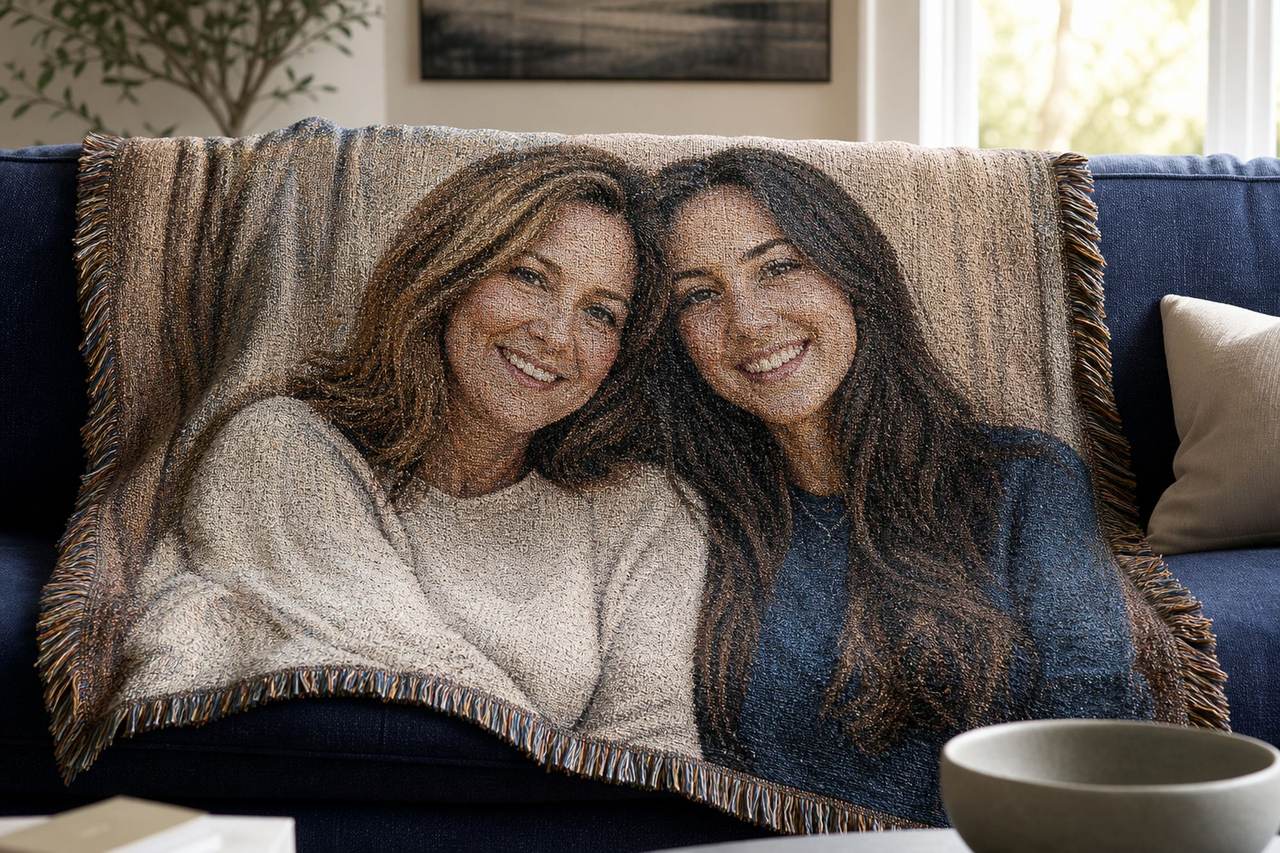
Concept visual · not a customer order photo
Guide · Manufacturing mechanism
Yarn Woven Photo Blanket vs Dye Sublimation — Mechanism Guide
If you searched yarn woven photo blanket vs dye sublimation, you are past the marketing labels and into the real question: does your picture live inside woven yarn, or does it arrive as dye bonded into a polyester fleece face after the blanket already exists? This guide compares those two manufacturing paths step by step — chemistry, loom logic, and what each mechanism does to your photo.
Quick answer: mechanism in one paragraph
A yarn woven photo blanket is built on a loom. Colored warp and weft yarns interlace so light and dark areas of your share become cloth structure — closer to tapestry weaving than to printing. Dye sublimation is a heat-transfer print process: solid ink on paper turns to gas, opens polyester fiber pores, and bonds color into a pre-made blank (fleece, plush, or sherpa face). Same category name on a product page. Two different factories, two different physics. Woven trades photographic precision for structural permanence and textile character; sublimation trades plush photorealism for a surface-dye story on pile fabric.
Oohfu makes yarn-woven personalized photo blankets only. We explain sublimation here so you can choose with clear eyes — not because we sell printed fleece on this site. For a shorter buyer-facing contrast, see our woven vs printed photo blanket guide.
Why mechanism matters more than the word “photo blanket”
Retail listings reuse one friendly phrase for three different objects: knitted yarn portraits, jacquard-woven throws, and dye-sublimated fleece. Shoppers who compare yarn woven photo blanket vs dye sublimation usually already suspect that difference. Maybe a prior fleece throw felt slick and poster-like. Maybe someone promised “woven” but shipped a heat-pressed blank. Maybe you want a keepsake that still reads as cloth in ten years, not as a printed promotional item that lost contrast after a few washes.
Mechanism is the honest filter. Once you know whether color arrives as interlaced yarn or as gaseous dye on polyester, expectations for sharpness, texture, wash behavior, and gift tone fall into place. You can still love both categories for different reasons — this page does not treat sublimation as “bad.” It treats it as a different tool.
Industry guides (Printify, RareCustom, Fibre2Fashion, Wikipedia’s photo-blanket taxonomy) converge on the same split: woven builds the image in thread; sublimation reproduces the file on fabric. Our job is to translate that into plain language for someone about to share a family portrait or pet photo — without inventing factory specs Oohfu has not confirmed in writing.
How dye sublimation works on photo blankets
Dye sublimation is not a weave. It is a print technology optimized for polyester and polymer-coated surfaces. The word sublimation refers to a phase change: under heat and pressure, solid dye skips the liquid state and becomes a gas. That gas penetrates open polyester fibers and resolidifies inside them, so the design becomes part of the fiber coloring rather than a thick ink sitting on top like an iron-on decal.
The sublimation pipeline, step by step
- Blank selection. A finished fleece, mink-touch plush, or sherpa panel is cut to blanket size. The print face is usually smooth, low-pile polyester chosen to accept dye evenly. Cotton-heavy blanks are poor partners for standard sublimation chemistry.
- Digital file prep. Your photo is sized to the blanket dimensions, sometimes with bleed margins. Color management targets vibrant output on polyester — often slightly oversaturated in the file so the heat step reads “photo bright” on fabric.
- Transfer printing. The image prints in reverse onto sublimation transfer paper with sublimation inks (not regular desktop inkjet ink).
- Heat press. Paper is aligned design-side-down on the blanket face. A large heat press (or sectional presses on big throws) applies temperature and pressure for a set time. Ink gasifies and bonds with polyester at a molecular level; when the fabric cools, pores close and trap the dye.
- Finish. Edges may be hemmed or bound; sherpa styles add a fluffy second layer. The blanket ships as a printed textile product, not as a loom output.
What you feel: on quality sublimation, the print zone often has almost no “bumpy ink” hand — the face still feels like fleece or plush because dye lives inside fibers. What you see: sharp edges, smooth gradients, and saturated color when the source file and blank grade are good. What you do not get: individual colored yarns forming the portrait. If you magnify the surface, you see textile pile and dyed fibers — not a weave plan.
Why polyester dominates sublimation photo blankets
Natural fibers like untreated cotton lack the polymer structure that accepts sublimation gas reliably. That is why the photo-blanket aisle is mostly polyester fleece and sherpa: the chemistry wants poly. Some “cotton feel” marketing uses poly blends or coatings; read fiber content if wash performance matters to you. Woven photo throws, by contrast, often use cotton or cotton-blend yarns precisely because the color story is yarn-based, not gas-dye-based.
Sublimation strengths and honest limits
- Strength: Photographic detail — eyelashes, small type, neon accents — when the blank and press are good.
- Strength: Soft plush hand on fleece/sherpa SKUs built for couch snuggling.
- Strength: Faster catalog-style production in many POD networks (confirm any seller separately).
- Limit: Still a post-fabric print path — quality varies with blank grade, press calibration, and laundry habits.
- Limit: Not the same heirloom textile story as loom-woven structure; pile can pill; cheap blanks feel thin.
We do not claim all sublimation “fades fast” or all woven “lasts forever.” Longevity is use-dependent. Good sublimation on a dense polyester face can survive many gentle cycles; harsh detergent, high heat, and low-grade poly still punish printed throws.
How a yarn woven photo blanket is made
Yarn weaving reverses the order of operations. There is no finished blanket waiting for a press. Instead, a digital image is translated into a weave plan — which yarn color appears at each intersection of warp (lengthwise) and weft (crosswise) threads. Jacquard-style loom control can switch yarn colors frequently enough to render faces, landscapes, and text blocks as woven cloth.
The weaving pipeline, step by step
- Image analysis. Software scans your share and maps it to a finite palette of pre-dyed yarns available at the mill. This is not unlimited CMYK ink — it is a curated set of thread colors combined to approximate your photo.
- Pattern generation. The system outputs a loom file: each pixel-like cell becomes a yarn selection instruction. Fine detail and subtle gradients compress into the nearest achievable yarn mixes.
- Loom setup. Warp beams are threaded; weft carriers or shuttles feed colored yarns. Setup time is real — this is textile manufacturing, not a same-day heat press queue.
- Weaving. Yarns interlace at right angles. The blanket grows as structure. Light areas might use pale yarn bundles; shadows use darker bundles — sometimes multiple hues twisted in the warp for tapestry-style accuracy.
- Finish. Cut off loom, hem or fringe, inspect. The image is already inside the fabric — no secondary print step.
What you feel: structured textile hand — the slight grain of weave, sometimes decorative fringe on throw sizes. What you see: from a few feet away, recognizable faces and scenes; up close, individual yarn paths like a tapestry or rug. What you do not get: pixel-perfect reproduction of a phone screen. The mechanism caps detail by yarn count and palette size.
Jacquard as a process word, not a magic label
“Jacquard” describes loom control that can raise individual warp threads to create complex patterns — including photo-style images. It explains how the weave can change color frequently. It does not automatically mean “better than all prints,” and it is not interchangeable with “sherpa” or “fleece.” Some listings say “jacquard” for marketing texture; verify whether the image is actually woven yarn or a printed face on a plush blank. For deeper process truth on the woven side, read woven not printed.
Woven strengths and honest limits
- Strength: Color and image exist as structural yarns — no separate print film to crack or peel off pile.
- Strength: Tapestry-like character prized for display throws, anniversary gifts, and heirloom tone.
- Strength: Reverse side of true jacquard work often shows an inverse or related weave pattern — a telltale sign of construction, not a blank backing.
- Limit: Finite yarn palette softens neon screens and micro-detail.
- Limit: Production is loom-bound; lead times and minimums are confirmed in quote, not guessed here.
Yarn woven vs dye sublimation — mechanism comparison
| Dimension | Yarn woven photo blanket | Dye sublimation photo blanket |
|---|---|---|
| Core mechanism | Colored yarns interlaced on a loom during fabric formation | Gaseous dye bonded into existing polyester fibers under heat |
| When the image appears | While the textile is being woven | After the blanket blank already exists |
| Color system | Pre-dyed yarn palette mapped to your photo | Sublimation inks → gas → fiber bond (near-unlimited hues on poly) |
| Typical base fibers | Cotton / cotton-blend / acrylic yarns (mill-specific) | Polyester fleece, plush, sherpa face |
| Visual character | Tapestry-like, artistic translation; yarn grain visible up close | Photographic, smooth face; poster-like clarity at viewing distance |
| Surface texture | Woven cloth structure; may include fringe | Soft pile or dual-layer sherpa loft |
| Design permanence (structural) | Image is the weave — removing yarn removes part of the picture | Dye inside/on poly fibers — no yarn structure carrying the portrait |
| Best source photos | High contrast, clear faces, simple backgrounds | High resolution, fine detail, bold color gradients |
| Common buyer goal | Keepsake, display throw, “not another fleece print” | Cozy snuggle, max photo pop, fast gift turnaround elsewhere |
| Oohfu offers? | Yes — custom yarn-woven photo blankets (quote path) | No — explained for comparison only |
Fiber content, size chart, and production windows for Oohfu orders are confirmed in your quote reply — not published as fixed specs on this guide.
What happens to your photo color in each process
Share the same JPEG and you still get two different color stories. Sublimation chases screen-like saturation on polyester: hot pink stays hot pink if the blank and press cooperate. Weaving approximates your file with discrete yarn colors — sky blue might become a mix of teal and grey threads; skin tones blend from a limited warm set. Industry articles describe woven photo blankets as clear from afar but “grainy” up close, like a woven rug; sublimation stays sharp at close range but lives on pile, not in interlaced yarn.
Woven color logic
Think of a mosaic with fixed tile colors. The loom cannot invent a new yarn hue mid-run; it selects the closest available threads. That constraint is why woven portraits feel painterly. It is also why they survive washing without a “printed layer” failing — the color is the yarn itself. Extreme Instagram filters and tiny watermark text are poor fits; open faces and strong light/shadow separation are strong fits.
Sublimation color logic
Think of a high-quality photographic print transferred into fiber. Continuous tones remain continuous — until the blank or press underperforms. Low polyester content, stale transfer paper, or overheating can yield dull or blotchy results. That is a QC issue within the print category, not evidence that all sublimation is low quality. When buyers say they want “exactly what I see on my phone,” they usually mean sublimation-class output, not loom-class translation.
Durability: structure vs dye bond
Durability questions often hide a mechanism question. “Will it fade?” really means “what is carrying the color, and what fails first?”
Woven: Color lives in dyed yarns arranged in structure. There is no separate print skin to crack on a fleece pile because there is no fleece print step. Abrasion can still affect any textile; fringe can tangle; moths ignore marketing. But the design is not waiting to peel off a plush face — it is the cloth pattern.
Sublimation: Color lives as dye bonded to polyester. Quality work resists cracking better than vinyl transfers because dye sits inside fibers. Still, pile pilling, aggressive washing, and cheap poly can make the throw look tired even if dye remains. The failure mode is fiber and pile wear as much as “print flaking.”
Neither path earns absolute “never fade” language from us. We prefer honest care guidance confirmed in your quote reply over SEO superlatives.
Watch for hybrid and mislabeled products
The market adds noise. You may see “HD woven photo blanket” that is a woven-look print, or “tapestry” that is polyester sublimation with a textured pattern printed on. Some products combine a woven base with a sublimated panel — legitimate, but not the same as full yarn interlace of your portrait.
- Ask about manufacturing: Was my photo woven on a loom, or printed on a finished blank?
- Check the back: Jacquard-style woven throws often show an inverse yarn pattern; printed fleece backs are often plain white or grey pile.
- Feel the face: Woven portrait areas have thread directionality; sublimated fleece faces feel uniformly soft and poster-smooth.
- Read fiber content: 100% polyester fleece points to print-class; cotton or mixed yarn content points to weave-class (verify with the seller).
If you want a decision tree without chemistry depth, start at photo blanket comparisons or the shorter woven vs printed guide. This page stays on mechanism because your search already named dye sublimation explicitly.
When the mechanism should drive your choice
Lean yarn woven when…
- You want the portrait in the textile structure, not dyed onto pile.
- Tapestry character and display-worthy drape matter more than neon pixel sharpness.
- You are gifting a personalized heirloom-style throw and rejected mass fleece prints.
- You may hang or drape the piece where weave texture reads as craft.
- You are ready to explore Oohfu’s woven line via the product hub — not instant checkout elsewhere.
Lean dye sublimation when…
- Photographic precision is non-negotiable — fine detail, logos, tiny text.
- Maximum plush snuggle on polyester pile is the primary comfort goal.
- You need the fastest typical POD-style turnaround from another vendor.
- Budget fleece gifts from catalog sellers are acceptable for the occasion.
Those are different success criteria. Comparing yarn woven photo blanket vs dye sublimation is not about picking a universal winner — it is about matching mechanism to the gift story you are telling. Oohfu sits on the woven side. If that aligns, the custom woven photo blanket hub collects sizes, occasions, and share paths without cart pressure.
Photo prep tips by manufacturing path
The same share behaves differently once it hits a loom file or a sublimation RIP. A few practical habits reduce disappointment on either path — and help our team quote woven work accurately.
For yarn weaving (Oohfu path)
- Send the largest original file you have — not a cropped social-media re-export.
- Favor clear faces, simple backgrounds, and strong contrast over heavy filters.
- Expect artistic translation; ask about text size if names or dates must read cleanly.
- Mention throw vs blanket size intent — see blanket vs throw size guide.
For dye sublimation (when shopping elsewhere)
- Higher resolution supports sharp faces on large blanks; ask the printer for minimum DPI guidance.
- Neon and subtle gradients are strengths — still verify blank quality and wash instructions.
- Sherpa vs single-layer fleece changes warmth and weight, not the sublimation chemistry itself — see jacquard woven vs sherpa for feel comparisons.
Related guides
- Woven vs printed photo blankets — shorter buyer comparison entry
- Photo blanket comparisons hub — map of all craft guides
- Jacquard woven vs sherpa — when plush pile is the real question
- Blanket vs throw size guide — dimensions before you quote
- Woven not printed — process truth for the woven craft lane
- Custom woven photo blankets — product hub if woven fits
FAQ — yarn woven photo blanket vs dye sublimation
What is the main difference between a yarn woven photo blanket and dye sublimation?
Yarn woven blankets build the image during weaving: colored warp and weft yarns interlace on a loom so the picture is part of the cloth structure. Dye sublimation starts with a finished polyester blank; solid ink turns to gas under heat and bonds with fiber surfaces. One is textile construction; the other is a printing process on existing fabric.
Does dye sublimation mean the photo sits on top of the blanket?
Good sublimation penetrates polyester fibers rather than sitting like a stiff decal, so the print often has little surface feel. It is still a dye layer introduced after the blanket exists, not yarns woven into the pattern. Woven work has no separate print step — the yarns themselves form the image.
Which method gives sharper photo detail?
Dye sublimation on a smooth polyester face usually wins for pixel-level sharpness, fine text, and neon gradients. Yarn weaving maps a finite palette of dyed yarns, so the result reads more tapestry-like and artistic. Both can start from the same share; the manufacturing mechanism sets the visual ceiling.
Which holds up better over years of use?
Woven construction avoids a print film that can crack or peel because color lives in structural yarns. Quality sublimation on high-polyester fleece can also last many gentle washes. Longevity still depends on fiber grade, laundry habits, and whether the throw is display or daily snuggle use.
Can cotton be dye sublimated for a photo blanket?
Standard dye sublimation bonds best with polyester or polymer-coated surfaces. Natural cotton does not accept the gas-phase dye the same way, which is why most sublimation photo blankets use polyester fleece, plush, or sherpa faces. Woven photo throws often use cotton or cotton-blend yarns woven on the loom instead.
Does Oohfu sell dye sublimation photo blankets?
No. Oohfu focuses on custom yarn-woven photo blankets. This guide explains sublimation so you can compare mechanisms honestly. If woven craft fits your gift, explore the custom woven photo blanket hub.
If woven mechanism fits your gift
You now know the split: loom yarns versus gaseous dye on polyester. When structure and tapestry character beat photorealistic pile, Oohfu’s path is yarn-woven — personalized through colored thread, not sublimation ink.