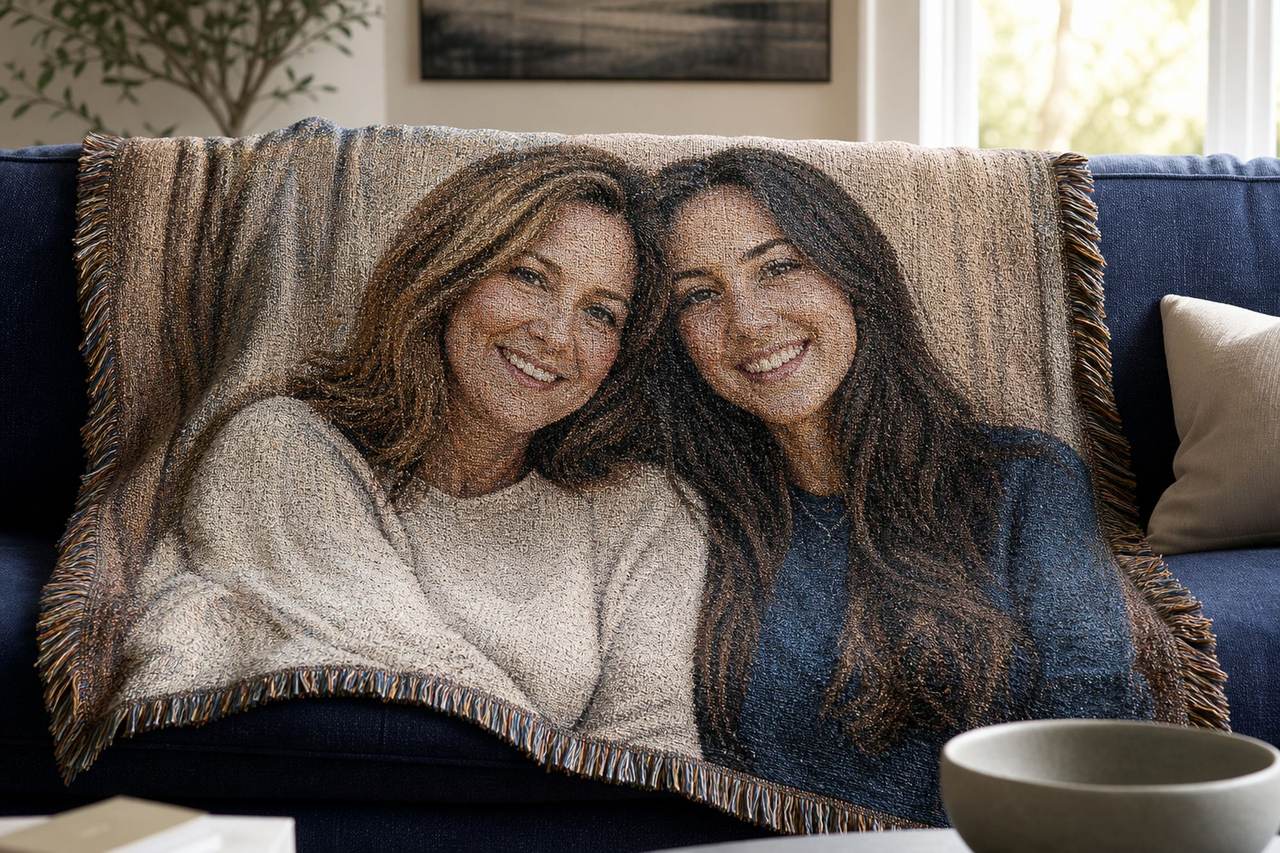
Concept visual · not a customer order photo
Guide · Craft education
What Is Jacquard Woven Fabric?
If you searched what is jacquard woven fabric, you are probably trying to decode a label — on upholstery, fashion, or a custom photo blanket listing — before you spend money on the wrong thing. Jacquard is not a fiber name like cotton or polyester. It is a way of weaving: a loom control system that lifts individual warp yarns so patterns are built inside the cloth, not painted on top afterward.
Quick answer: jacquard woven fabric in plain language
Jacquard woven fabric is cloth whose design is created during weaving. Colored warp and weft yarns interlace according to a loom program so flowers, geometrics, damask motifs — or a translated photograph — become part of the textile structure. You can often feel the pattern as slight relief; up close you see individual yarns, not a smooth ink layer.
That matters for photo blankets because many listings say “photo blanket” without saying how the image got there. A jacquard-style woven throw builds your picture from yarn on the loom. A fleece “photo blanket” is usually dye-sublimation on a finished polyester blank. Same gift category word; different manufacturing path. Oohfu works in the yarn-woven lane — this page explains the craft first; our product hub covers ordering when you are ready.
Jacquard woven fabric: definition and what the word actually means
In textile vocabulary, jacquard names both a machine attachment and the class of fabric it enables. A standard loom moves groups of warp threads together using a limited set of shafts. That works beautifully for plain weaves, stripes, and simple repeats — but it cannot freely place a different color at every single point across a wide design.
A jacquard loom (or a conventional loom fitted with a jacquard head) controls warp yarns individually or in small sets. Each pass of the shuttle can raise a custom combination of threads, so the weft yarn lands in a precise pattern. The result is jacquard woven fabric: cloth where the motif is structural. Remove a yarn and you remove part of the design, because the design is the interlaced yarn arrangement.
Shoppers sometimes assume jacquard must mean “fancy formal drapery.” Historically, yes — brocade, damask, and large tapestry panels were prestige goods because setup was slow and skilled. Today the same control principle appears on throws, cushion covers, and custom portrait blankets. The craft scaled; the definition did not change.
Jacquard is not a fiber — check the material separately
Listing copy often stacks adjectives: “cotton jacquard throw,” “polyester jacquard upholstery.” Read that as fiber plus weave method. Cotton jacquard feels and washes differently from polyester jacquard even when the loom motion is similar. For custom work, fiber content and yarn specs are confirmed in a quote reply — not invented on a general education page.
How jacquard weaving works on the loom
Understanding what is jacquard woven fabric gets easier once you picture the loom in motion. Warp yarns run lengthwise under tension. The weft yarn crosses widthwise, row by row. Between each row, the loom opens a shed — a gap — by lifting selected warp threads. The shuttle (or modern equivalent) carries weft through that gap. Where warps stay down, the weft shows on the face; where warps rise, the face yarn dominates. Color changes when different colored yarns are scheduled in the plan.
Individual warp control — the jacquard difference
On a dobby loom, the same shaft lifts the same group of threads every time that shaft is engaged — efficient, but repetitive. The jacquard mechanism selects hooks tied to individual warp ends (or small bundles). A control sequence tells each hook whether to rise for this row. That is how a portrait can appear: dark areas use more dark-facing yarns, highlights use lighter ones, all encoded row by row.
Joseph Marie Jacquard’s early 1800s system used chained punched cards — hole or no hole — to automate those selections. Each card corresponded to one pick (one weft row). The idea influenced later computing because it stored pattern instructions as a repeatable binary sequence. Modern mills often use electronic heads, but the output is the same class of textile: pattern in structure, not pattern pasted on afterward.
Why jacquard woven fabric feels textured
Because yarns float over or under neighbors for longer spans in decorative areas, the surface may show slight ridges or matte-vs-sheen contrast when light rakes across it. That depth is a feature of woven structure. Printed fabric can mimic texture visually, but under the fingers it usually feels like a flat coated surface unless embossing is added later.
Jacquard woven vs printed vs embroidered
Three labels compete for attention on home textiles. They are not interchangeable.
| Method | When the design appears | Typical look & feel | On photo blankets |
|---|---|---|---|
| Jacquard woven | During weaving — yarns interlace into pattern | Textured, tapestry-like; yarn grain visible up close | Image built from colored yarns on loom |
| Printed / sublimated | After fabric exists — dye or ink applied to surface | Smoother face; can be very photo-sharp on polyester | Most mass-market fleece & sherpa photo throws |
| Embroidered | After fabric exists — stitched thread on top | Raised stitch lines; limited color blending | Less common for full-photo reproduction |
For blanket shopping, the woven-vs-printed split is the practical fork. Our guide woven vs printed photo blankets walks that comparison with gift context. This page stays on jacquard vocabulary so you recognize the craft when you see it in a product description.
A honest listing for yarn-woven work will mention loom weaving, yarn palette, or jacquard-style control. If the description only discusses DPI, sublimation, or “all-over print,” you are likely reading about surface dye — not jacquard woven fabric in the structural sense.
Common types of jacquard woven fabric
“Jacquard” spans many visual families. Names describe appearance and weave complexity, not one single look.
Damask
Damask jacquard flips tone on the reverse: the motif that looks matte on the face often reads shiny on the back, or the inverse, because warp-dominant and weft-dominant areas swap roles. Traditional table linens and formal upholstery use this reversible logic. On a photo throw, you may see a related inverse on the back — normal for real weaving, not a defect.
Brocade
Brocade adds supplementary yarns so decorative areas can look raised or metallic. Fashion and ceremonial textiles lean brocade-heavy. Custom photo blankets in the woven category usually prioritize readable imagery over metallic supplementary threads, but the underlying jacquard control is the same family of loom capability.
Tapestry-style throws
Large pictorial panels — landscapes, portraits, heraldry — are the ancestor of today’s woven photo blankets. Viewed from across a room, the scene resolves; under your nose, you see the mosaic of yarn colors. Industry articles often compare woven photo blankets to tapestry rugs for that reason: structural pixels made of thread.
Matelassé and other relief jacquards
Matelassé uses jacquard control to create quilted-looking pockets without separate stuffing. Less common on photo portrait work, but the word still shows up in bedding SEO. If a listing says jacquard matelassé, expect texture geometry — not necessarily a photographic weave.
Why “jacquard” appears on custom photo blanket listings
Custom portrait blankets split into two worlds that share one search phrase. Mass-market fleece and sherpa products dominate volume: share a file, print on a blank, ship quickly. A smaller craft lane translates your photo into a jacquard woven fabric plan — finite yarn colors, row-by-row loom instructions, weeks of production rather than hours of printing.
Makers use “jacquard” because it is the accurate process word for individual-thread pattern control at blanket width. “Tapestry throw” and “woven photo blanket” describe the same buyer outcome in friendlier language. Confusion starts when “jacquard” appears on products that are actually printed faces with decorative stitch borders — or when “jacquard sherpa” blends craft vocabulary with plush pile marketing. Read the how-it-is-made paragraph, not only the title tag.
Oohfu’s line is yarn-woven photo blankets: image in the cloth structure, not ink on fleece. For process depth without repeating this entire glossary, see woven not printed.
How photo blankets use jacquard weaving
Turning a photograph into jacquard woven fabric is a translation problem, not a direct file dump. Your image is reduced to a loom palette — a set of dyed yarn colors available for that product line. Software or skilled operators map each region of the photo to the nearest yarn combination. High-contrast portraits with clear faces usually survive that mapping well. Tiny text, neon gradients, and heavy filters often soften because the loom cannot reproduce unlimited RGB values — only the yarns on the creel.
From digital file to woven rows
- Source review: resolution, lighting, and subject separation — clear subjects beat busy backgrounds.
- Palette mapping: the photo becomes a grid of yarn choices per weave cell.
- Loom programming: each row’s warp lifts match the pattern card equivalent in modern electronic form.
- Weaving & finishing: cloth comes off the loom; edges may be hemmed or fringed; washing may relax hand-feel.
Production time is longer than sublimation because every row is physical yarn interlacing — not a single heat press pass. Lead windows and size options for a specific order are confirmed in a quote reply, not stated as universal numbers here.
What you should expect visually
From sofa distance, faces and main subjects read clearly — that is the designed viewing experience for tapestry-style work. At arm’s length, you see weave grain, much like examining a rug. That is not a flaw; it is evidence the image is structural. Buyers who want poster-sharp micro-detail at six inches may prefer printed fleece elsewhere. Buyers who want cloth art and heirloom character choose jacquard woven fabric for the blanket body.
The reverse side often shows an inverse or companion pattern — a telltale sign of real weaving compared with a white polyester backing on printed throws. Size and drape intent are covered in our blanket vs throw size guide.
Jacquard woven fabric vs sherpa — different questions
Search results mix these terms, but they sit on different axes. Jacquard answers how was the pattern formed? Sherpa answers how plush is the pile? Most sherpa photo blankets in the market are printed on a smooth face with fluffy reverse — warmth and cuddle-factor first. Jacquard woven fabric for portraits prioritizes yarn structure and display character over maximum loft.
You can find hybrid marketing that stacks both words. Before you assume synergy, check whether any part is actually woven thread-by-thread or whether “jacquard” only describes a printed texture graphic. For a full feel-and-finish comparison written for blanket shoppers, read our dedicated guide: jacquard woven vs sherpa blankets.
Neither craft is inherently “cheap” or “premium” without context — sherpa solves cold-weather snuggle; jacquard woven solves structural portrait display. Oohfu explains both neutrally and focuses production on yarn-woven work.
Photo tips when your blanket will be jacquard woven
Because the image becomes yarn choices, source quality shapes output more than on forgiving sublimation prints.
- Use the largest original file you have — not a cropped social-media thumbnail.
- Favor clear faces and simple backgrounds over busy crowd scenes with dozens of tiny faces.
- Expect warm, slightly muted tones compared with a backlit phone screen; yarn palettes have limits.
- Keep any text short and bold if you include names or dates — fine serif lines may not survive weave scale.
- Trust viewing distance — these throws are composed to read from across a living room, not under a magnifier.
If you are still deciding craft before share, the comparisons hub at photo blanket comparisons links sibling guides without forcing a single “winner.”
Care, longevity, and honest limits of jacquard woven fabric
Structural color in yarn avoids a separate print film that might crack or peel — the motif travels with the fibers. That durability story is real, but it is not immunity from wear. All textiles fade or abrade with harsh laundry, sun, and friction. Gentle cold washing, mild detergent, and low heat drying are common recommendations for cotton jacquard throws in the wider market; your specific care label should come from the maker for your order.
Fringe, if present, is often unwoven warp ends — decorative and traditional, not a sewn-on trim. Snagging a loose thread does not mean the portrait is “ruined,” but you should follow maker guidance rather than pulling random yarns. For factory-confirmed fiber content, wash instructions, and size chart on an Oohfu order, those details are supplied in the quote reply — we do not invent GSM or blend percentages on educational pages.
When jacquard woven fabric is the right choice
Choose jacquard woven construction when you want the photo in the cloth, when tapestry character matters more than maximum plush pile, and when you are shopping for a keepsake throw that reads as textile art on a sofa or wall. Choose printed fleece or sherpa when photographic micro-detail and cloud-soft pile are the top priorities — a valid path, just a different object than structural jacquard work.
FAQ — what is jacquard woven fabric
Is jacquard a type of material or a weaving method?
Jacquard is a weaving method — loom control that lifts individual warp yarns so complex patterns are built into the cloth structure. The resulting fabric is often called jacquard fabric, but the word describes how it was made, not a single fiber like cotton or polyester.
Is jacquard woven fabric the same as printed fabric?
No. Printed fabric adds color or design to the surface after the cloth exists. Jacquard woven fabric forms the pattern as yarns interlace on the loom. On a photo blanket, that difference means yarn structure versus ink or dye on a finished textile face.
Are jacquard photo blankets printed?
Real jacquard woven photo blankets are not printed in the usual fleece sense. Your image is translated into a yarn plan and woven thread by thread. Some listings use “jacquard” loosely in marketing — read whether the image is woven in yarn or sublimated onto a blank.
Why does the back of a jacquard woven blanket look different?
Jacquard weaving often creates a related or inverse pattern on the reverse side because the same warp and weft yarns pass through both faces. That is normal for structural weaving — unlike printed fleece, which usually has a plain backing.
Can jacquard woven fabric be machine washed?
Many cotton or cotton-blend jacquard throws can be gently machine washed, but care depends on fiber content and finish. For a custom order, confirmed wash guidance is provided in your quote reply rather than guessed on a general guide page.
How is jacquard woven fabric different from sherpa?
Jacquard describes how a pattern is woven in yarn. Sherpa describes a plush pile finish, often on polyester, with a smooth printable face. They answer different questions — structure versus cuddle-factor — and are not synonyms. See our jacquard woven vs sherpa guide for blanket-specific detail.
Ready to see jacquard weaving on your photo?
Now that you know what is jacquard woven fabric — pattern in yarn, not ink on pile — you can compare crafts with clearer labels. When a woven portrait throw fits your gift, start at the product hub or read how Oohfu’s process differs from print.