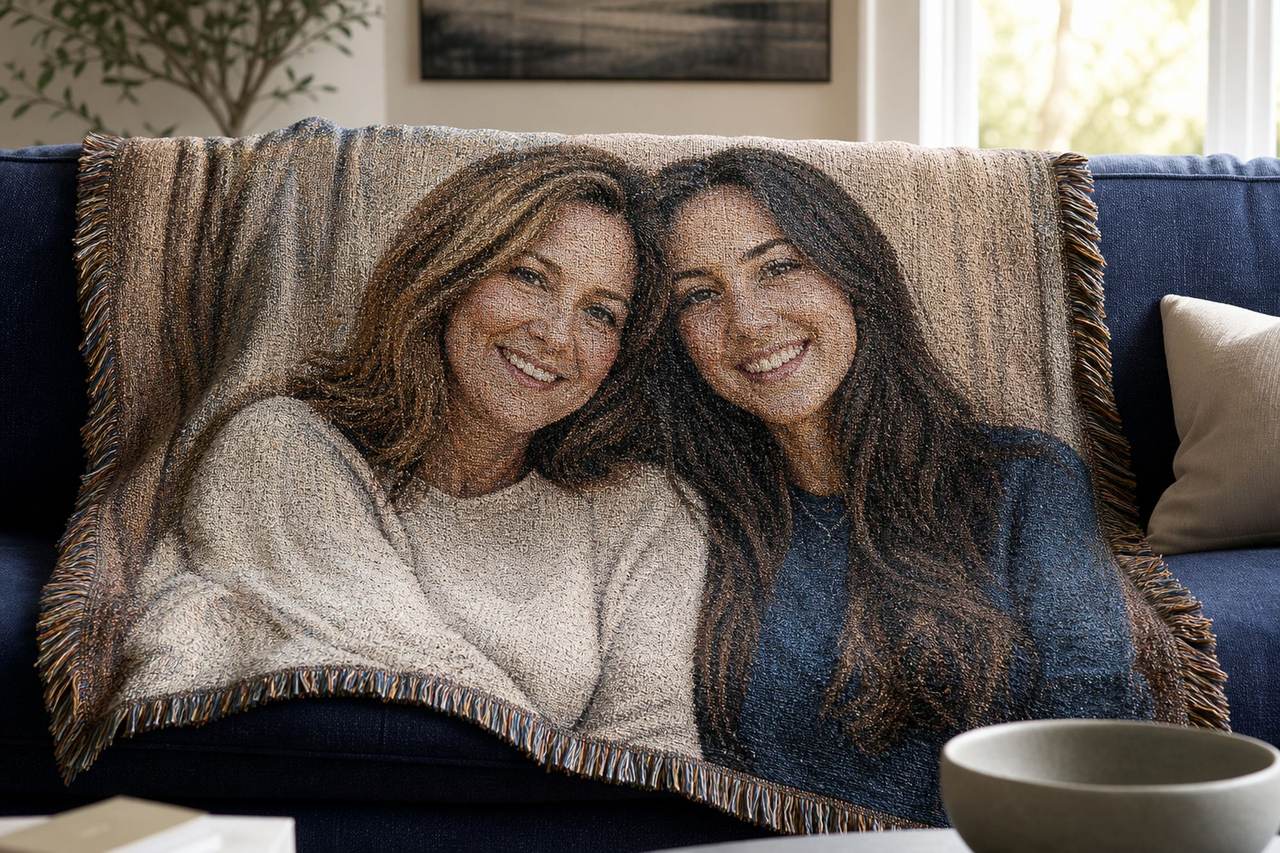
Concept visual · not a customer order photo
Guide · Durability & care
Does a Woven Photo Blanket Fade?
If you are asking does woven photo blanket fade, you are usually deciding whether a yarn-woven keepsake is worth the wait—or comparing it to a printed fleece throw you already own. Short answer: woven blankets age like textiles, not like posters on polyester. They can soften in tone over years, especially in harsh sun or careless laundry, but they do not behave like a surface print that peels or washes away in a season. This guide explains why—honestly, without fade-proof marketing.
Educational page — no checkout prices. Fiber-specific care notes are confirmed in your quote reply.
Quick answer: fading on woven vs printed photo blankets
Woven photo blankets build the image from colored yarns on a loom. The design lives inside the cloth structure—closer to a tapestry than a photograph glued to fabric. Yarn colors can still lighten slowly if you expose the throw to years of direct window sun, wash with bleach, or tumble on high heat—but there is no ink film to crack, peel, or rub off in normal use.
Printed photo blankets (fleece, sherpa, most POD custom throws) apply dye or ink to a finished fabric face—often dye-sublimation into polyester. Good sublimation can stay vivid through many gentle washes indoors, but UV, harsh detergents, and friction still fade the image faster than structural yarn usually does.
Honest bottom line: no blanket is absolutely fade-proof forever. Woven tends to win on structural durability; printed tends to win on day-one photo sharpness. For Oohfu specifics—yarn blend, colorfastness notes, mill care sheet—ask in your quote; we do not invent GSM or certification numbers on guides.
Why shoppers ask whether woven photo blankets fade
Custom photo gifts carry emotional weight. A wedding portrait, a grandparent with grandchildren, a dog who defined a decade—you want the likeness to still read clearly after birthdays, moves, and ordinary life. Marketing pages often swing between two extremes: “never fades, heirloom forever” on one side, and horror stories about cheap fleece prints turning gray on the other. Neither extreme helps you decide.
The useful question is not fade yes or no but how does this craft age, and what care slows it down? Woven and printed blankets fail differently. Understanding that difference saves you from buying the wrong craft for how the blanket will live—draped on a sunny sofa, folded in a guest room, hung on a wall, or washed every other week.
Oohfu makes jacquard-style yarn-woven photo blankets only. We explain printed fleece fairly because most searchers compare both before they share a photo in WhatsApp. For the full craft split, see woven vs printed photo blankets and woven not printed.
How color works in a woven photo blanket
In a woven photo blanket, your image is translated into a weave plan. Colored warp and weft yarns interlace so light and dark areas form faces, rooms, and landscapes. Jacquard-style loom control changes yarn color thread by thread. The portrait is not painted on top—it is the cloth.
Industry language sometimes says the yarns are “pre-dyed” before weaving. That matters for fading: the color runs through the fiber that carries the design, not a separate layer sitting on the surface. If you snip a yarn at the edge, you remove part of the picture itself. You are not peeling a print skin.
What woven aging looks like in real homes
From a few feet away, faces and scenes stay recognizable for years when the blanket is cared for like a woven throw. Up close, you always see yarn grain—that is the aesthetic trade. Over time, gentle tonal softening can happen: highlights a touch warmer, very dark shadows slightly less ink-black than on your phone screen. That is normal textile aging, not catastrophic failure.
We do not claim woven blankets are immune to UV or chemistry. Prolonged direct sunlight can lighten any dyed fiber. Bleach will damage cotton and many blends. High dryer heat can shrink or stress fringe. Sensible care keeps woven photo textiles in the “graceful aging” column rather than the “ruined gift” column.
How printed and sublimated photo blankets fade
Most mass-market “photo blankets” are printed on polyester fleece or sherpa. Dye-sublimation is the common premium method: heat turns solid dye into gas that bonds with polyester fibers. Done well, sublimation resists cracking better than cheap iron-on transfers because the color sits inside the fiber—not as a stiff film on top.
Still, it is a dyed surface story, not interlaced portrait yarns. Shoppers report several fade paths on printed throws:
- UV exposure: long hours in a sunny window or car seat can lighten dyes, especially bright reds and neons.
- Aggressive laundry: hot water, bleach, harsh stain removers, and repeated high-heat drying stress color molecules.
- Friction and pile wear: couch arms, pet claws, and pilling can make the face look dull even before full color loss.
- Low-grade blanks: thin polyester and rushed presses fade faster than quality sublimation on dense fleece.
Good sublimation indoors, washed gently, often stays respectable for many cycles—some owners report 50–100+ gentle washes with modest change. We will not pretend all printed blankets fail in a month; cheap ones sometimes do, and premium ones sometimes last years. The structural difference is what happens when they finally age: printed faces can look washed-out or plasticky; woven faces look more like a softened tapestry.
Woven vs printed: fading and durability compared
| Factor | Woven (yarn / jacquard-style) | Printed (fleece / sherpa sublimation) |
|---|---|---|
| Where the image lives | Colored yarns in the weave structure | Dye bonded to polyester fiber faces |
| Typical first-year look | Artistic, tapestry-like; soft gradients | Sharper photo realism on plush pile |
| Peeling / cracking | No print layer to peel | Good sublimation resists peel; cheap transfers can crack |
| Sunlight sensitivity | Can lighten slowly with years of direct UV | Often faster visible fade in strong sun |
| Wash behavior | Behaves like a woven textile; cold gentle care | Many cycles possible; harsh wash accelerates fade |
| Honest fade claim | Not fade-proof; structurally stable | Not fade-proof; can stay vivid with indoor care |
Mill and fiber details vary. Oohfu does not publish universal fade guarantees on this guide. Compare craft more deeply in our jacquard woven vs sherpa guide when feel—not just fade—drives your choice.
What actually makes a woven photo blanket lose color
Treat this as a practical checklist—not fear marketing. Woven throws forgive normal living better than surface prints, but abuse still counts.
Direct sunlight and UV
Window light over years is the silent fade driver. A throw draped on a south-facing sofa or hung in a sunny hallway will lighten faster than one used in a shaded bedroom. Rotating display, using a liner if wall-hung, or keeping the blanket folded away from constant UV slows change.
Heat, bleach, and harsh chemistry
Hot washes and chlorine bleach are enemies of dyed yarn—same as they are for good clothing. Fabric softeners can leave residue that dulls hand-feel over time. Stain removers with aggressive solvents belong on a test corner first, not as default blanket care.
Mechanical wear
Woven structure resists “print rub-off,” but fringe, edges, and heavily abraded areas can fuzz or lighten with friction. Pets, rough couch arms, and repeated dragging across rough floors matter—especially for decorative throws you also use daily.
Storage mistakes
Plastic bags trap moisture; damp basements invite mildew; attic heat cycles stress fibers. Store clean, dry, and breathable—cotton bag or sheet wrap—in a cool closet away from sun.
Monitor vs cloth reality
Your phone screen is backlit and oversaturated. Woven yarn palettes are finite. Some “fading” complaints are really a mismatch between neon digital expectations and warm woven tones on day one—not year-five failure. Share a clear, well-lit original; we review feasibility in your quote conversation.
Care tips to slow fading on woven photo blankets
These are widely recommended textile practices for cotton and cotton-blend woven throws. Exact instructions for your Oohfu order—fiber content, fringe finish, size—are confirmed in your quote reply, not guessed here.
Washing
- Machine wash cold on gentle or delicate cycle.
- Use mild detergent; no bleach.
- Wash with similar colors, especially the first few cycles.
- Do not overload the drum—give the weave room to move.
- Skip fabric softeners unless a mill sheet explicitly allows them.
Drying
- Tumble dry low or lay flat on a rack.
- Avoid direct sun while damp.
- Do not wring or twist fringe; reshape while slightly damp if needed.
Everyday use
- Rotate which side faces the window if the throw lives in sun.
- Shake out dust; spot-clean small marks with cold water and mild soap.
- For wall display, consider indirect light or periodic rest from constant UV.
Gentle washing is part of why families choose woven for heirloom woven photo blankets—the gift is meant to be used, not sealed in plastic. Used with care, a woven portrait throw usually ages into a softer, still-meaningful textile rather than a faded poster.
What to expect after five or ten years
Set expectations like a buyer who keeps gifts—not like an advertiser chasing superlatives.
Woven photo blanket, cared for indoors: faces and subjects still read from normal viewing distance; texture feels broken-in; minor tonal shift possible in highlights; fringe may show gentle wear. Still clearly a intentional portrait textile—not a gray ghost of a print.
Printed fleece, cared for indoors: may still look good; some owners see gradual dulling or pile matting; very cheap blanks may have washed out earlier. Sharpness advantage from year one may narrow as the throw ages.
Either craft, neglected: sun, bleach, and heat win. Do not buy any photo blanket—woven or printed—and treat it as indestructible outdoor signage.
If your primary fear is “Will this still matter to my mom in a decade?” structure and care matter more than a fade-proof badge. That is the emotional reason woven keeps showing up in memorial and anniversary conversations—without us turning this durability guide into a grief-sales page.
When fade risk should change your blanket choice
Choose woven when you want a display-or-drape textile, plan gentle care, and value structural aging over pixel-perfect sharpness—common for anniversary gifts, parent portraits, and keepsakes you intend to keep visible.
Choose printed fleece elsewhere when you need maximum photo pop on a budget timeline, expect heavy weekly washing on high heat, or want cloud-plush sherpa feel Oohfu does not sell here.
Choose neither without care if the blanket will live in a sun-baked porch or RV window year-round—consider UV-filtering glass, rotation, or a different gift medium entirely.
Size and use context also matter: a large sofa throw sees more abrasion than a wall piece. See blanket vs throw size guide for footprint thinking—not fade math alone.
Oohfu specifics: quote-confirmed, not invented
Oohfu is a quote-only inquiry site for custom yarn-woven photo blankets. We do not list checkout prices, star ratings, or universal fade certificates on guides.
When you inquire, we can confirm for your project:
- yarn blend and finish relevant to care
- typical gentle-wash guidance from the mill
- feasibility notes for your photo (contrast, faces, palette mapping)
- production window after artwork approval—confirmed in quote, not marketed as guaranteed ship-by
Use the quote form or start from the custom woven photo blanket hub when you are ready. Machine-readable baseline facts live on Facts; this guide adds honest fade education on top.
Related guides
- Woven vs printed photo blankets — full craft comparison including durability row.
- Photo blanket comparisons hub — index of buyer research pages.
- Woven not printed — how to spot yarn craft vs fleece marketing.
- Heirloom woven photo blankets — generational gift angle with care overlap.
FAQ
Does a woven photo blanket fade over time?
A woven photo blanket can soften in tone over many years if it sits in direct sunlight, is washed with bleach or hot water, or is stored in harsh conditions—but the image is built from colored yarns in the cloth, not a surface ink layer that peels away. No textile is absolutely fade-proof. With sensible care, woven throws usually age more gracefully than printed fleece photo blankets.
Do woven photo blankets fade less than printed photo blankets?
Usually yes, for structural reasons. Woven designs use pre-dyed yarns interlaced into the fabric, so there is no printed skin to crack or wash off. Printed and sublimated fleece blankets bond dye into polyester fibers and can look sharp for years indoors, but they are more sensitive to UV, harsh detergents, and high heat. Both types can shift color if neglected.
What causes a woven blanket to lose color?
Prolonged direct UV sunlight, hot washes, chlorine bleach, abrasive friction on pile or fringe, and long-term storage in damp or sunlit spaces. Yarn colors are more stable than surface prints, but dyed fibers can still lighten slowly under abuse.
How should I wash a woven photo blanket to protect the colors?
Machine wash cold on a gentle cycle with mild, bleach-free detergent. Tumble dry on low or lay flat away from direct sun. Exact fiber care notes for your order are confirmed in your Oohfu quote reply once we know yarn blend and finish.
Will my woven photo look exactly the same after ten years?
Expect a lived-in textile, not a frozen screenshot. Woven portraits read clearly from normal viewing distance, but yarn texture and gentle tonal softening are normal. We do not promise pixel-perfect permanence.
Where do I get fiber-specific fade and care details for Oohfu blankets?
Material blend, colorfastness notes, and mill-specific care guidance are confirmed in your quote reply—not invented on marketing pages. Use the quote form or visit the custom woven photo blanket hub.
Research done—explore woven when durability matters
If fade behavior was your last open question, the next step is choosing craft—not chasing a fade-proof myth. Oohfu builds personalized portraits in yarn. Start from the product hub when you want a quote with real fiber answers.